Michael Chorost: Michael Chorost, author of <i>Rebuilt</i>, on cochlear implants

Winner of the 2006 PEN/USA Book Award for Creative Nonfiction

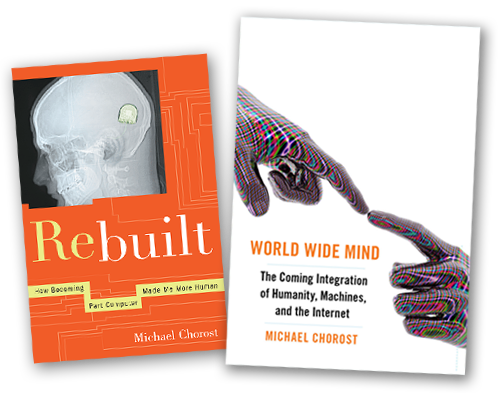
Rebuilt: How Becoming Part Computer Made Me More Human (Houghton Mifflin, 2005) is a scientific memoir of going deaf and getting my hearing back with a cochlear implant, that is, a computer embedded in my skull.  Science fiction writers and filmmakers have speculated about cyborgs (human-computer fusions) for decades, but in this book I reveal what it’s really like to have part of one’s body controlled by a computer.

Buy the hardcover or softcover on Amazon.

Download Chapter 1 (PDF)


RSS Feed Subscribe to RSS Feed.

July 30, 2008: Slips of the hand

Josh Swiller arrived this afternoon, and a bunch of other people did too, so now the dorm feels like an actual place instead of a deserted jail. I was here all by myself for ten days.

Slips of the hand: when I told someone that “my roommate” Josh was arriving, I used the sign for together: my together Josh. I walked away vaguely feeling that I had implied my companion Josh. I may be from San Francisco, but I’m not that kind of San Francisco.

And when a woman in my class signed Pleased to meet you, instead of signing meet by holding two fingers up vertically relative to each other, she held them horizontally: Pleased to have sex with you. I don’t know what the sign for “have sex” is yet, but the class took it that way and everyone broke up.

I’m studying for my final exam, and somehow I forgot the sign for forget. If you don’t know the sign for forgetting, does that mean you have to remember everything? I hope so.


July 25, 2008: Learning ASL

I’ve finished my first week of intensive American Sign Language (ASL) classes: six hours a day in class, an hour or two doing homework, and of course seeing people signing all over campus. So where have I got? I can say things like My name is (and fingerspell my name), Where do you come from, and How did you get here?

How did I get here?

I still have no idea, none at all, how tenses work, and I find it all but impossible to read fingerspelling. It just goes by too fast. After videotaping myself, I discovered to my chagrin that I couldn’t read my own fingerspelling. Did I really make that second o in my last name? I had to slow down the video to see that, yes, I had.

When they say “immersion” they mean it: no spoken English is used at all. There’s occasional writing on the board, and that’s it. It’s like figuring out a giant logic puzzle. Fortunately, I’ve got a good teacher: he’s funny, expressive, patient.

On the first day of class he showed a picture of a drill on the board, and made the sign for drill: the right index finger going through two fingers of the left hand. I was puzzled. Why teach us the sign for drill on the first day? Did woodworking hold a special place in deaf culture? Then he did a few signs we already knew, like name, and then drill again. Drill, I thought. Drill wood. Huh? Then he did a new sign, the right fist sliding against the left index finger, thumb pointing toward the body. Drill. New sign. Drill. New sign. I got that light-bulb aha moment — the new sign must mean a language drill. The sign means practice!

And then there’s the textbook, which almost never gives the definitions of individual signs, along with its CD-ROM, whose videos aren’t translated into English. You get an outline of the meaning of the conversation, and that’s it. You have to figure out what the signs mean on your own.

Of course, I cheated. I bought a dictionary. But often I can figure out the meaning on my own.

“ASL evolves,” my instructor sometimes says when explaining variants of a sign. The numbers 1 through 20 are all signed on one hand. But he signed the numbers 16 through 20 differently than the video. “Old people do it that way,” he signed to us, when we looked puzzled. (The sign for old is the fist descending from the chin, as if stroking a beard.) The video was done in 1993. “ASL evolves.”

ASL may evolve in a much more protean way than spoken languages, because it has no written form to fix it. A language unmoored from the page, busily reinvented by each new generation.

The first three days of class were a delight, a hummingbird whirl of puzzle-solving. The last two I’ve felt slower, stupider, not getting signs I would have gotten before, my hands not being able to form letters they could before. I think my mind is overloaded. Overheated. Tired. Too many signs. Need the weekend to rest and let my subconscious unblock the channels.

I look around the cafeteria and think: Fifty or a hundred years ago, many of the people here would have received no meaningful education in any language, which would have condemned them to a marginalized life. People with IQs of 130 pushing brooms. To earlier eras Gallaudet would seem like a paradise: bright clean buildings, classrooms full of students, and people conversing endlessly about whatever they want.

It’s not a paradise. Descend below the surface and you see a community trying to raise its academic standards, improve its graduation rate, and – most of all – groping for a new mission in a world where more and more deaf kids are getting cochlear implants and going to mainstream high schools and colleges. That puts the language, the culture, the university – in short, everything I see around me – at risk of vanishing.

But as David Crystal says in his book Language Death, which I’m reading now, each human language carries with it a unique and valuable way of looking at the world: a fresh set of perspectives for describing and meeting human needs. ASL is a visual language in a society dominated by the image, the icon, the picture. And, to turn the parallelism around, it’s a community-oriented language in a society where communities are falling apart.

Can ASL do something for the world that is unique, fresh, new, necessary?

It already has, of course. It’s had a profound impact on linguistics. Parents use it to communicate with their infants, whose motor skills mature sooner than their vocal skills. But these are niche impacts. Can ASL change English itself? Or find a new home in the technological infrastructure of our society, guaranteeing not only its own survival but also that of the culture that created it?

I don’t know. My working hypothesis is that it can.

How, I don’t know yet.

I think of the Jews, who prospered despite medieval repression by developing skills – such as banking – that were forbidden to their Christian neighbors. I think of Apple, which prospered not by playing the PC market better, but by creating entirely new markets.

I’m hoping that in the next ten months, new ideas will emerge.


July 17, 2008: @Gallaudet

Sometimes when a blogger goes offline for three months – my last post was April 18th – it’s because not much is going on. And sometimes it’s because a whole lot is going on.

Two weeks ago, my agent finalized a contract for me to write my second book, whose working title is World Wide Mind: The Coming Integration of Humans and Machines. The publisher is The Free Press, which is an imprint of Simon & Schuster. It took me three years to reach this point. I’m incredibly grateful to my agent, who shepherded me through half a dozen drafts of the book proposal, and to my family, who supported me in all sorts of ways. The book’ll come out in 2010 or 2011.

I’m writing this entry in Washington D.C., where I’ll be living for the next 10 months. I moved here three days ago. I’ll be a visiting professor at Gallaudet University, along with Josh Swiller. Together we’ll teach a course on how minority groups have adapted and survived in challenging times. The idea is to foster creative thinking on how Gallaudet can re-imagine itself in a time when technology is transforming deafness.

We’ll look at several ethnic minorities, but we’ll also discuss the survival of companies like Apple, languages like Welsh, and biological species such as black peppered moths. Josh and I are putting the syllabus together now, and we’re both very excited about it.

My life’s changed so fast that it’s been like jumping out of a plane with my shoes untied. I look out the window of my sixth-floor dorm suite, which has a beautiful view of the football field, and I ask myself, “What just happened?”

And, “What have I gotten myself into?” I’ve also committed myself to learning a new language – American Sign Language. I can fingerspell slowly, and I know a few dozen signs (day, week, month, and Thank you have proven especially helpful.) I’ll be starting an intensive ASL course on Monday.

I’m acutely aware that I’ve stepped into a whole different culture. I’m sure I’ll feel confused a good part of each day, and I apologize in advance for all the different subtle ways in which I’ll probably offend people (I understand that a certain sign for lunch, which I learned years ago, is out of favor; I have to unlearn even the little that I know!) But I’ve found that collisions with the new are the best way to keep myself alive and creative, and I’m very grateful to Gallaudet for welcoming me.

I gave a talk at Google just before I left, and you can see it on YouTube here. It’s a good preview of the themes of World Wide Mind. I’m well aware that the subtitle of my book is likely to perplex some people at Gallaudet, to say the least. But writing it here, where the integration of humans and machines is seen by some as a mortal threat, will keep me honest – and humane.


April 18, 2008: Living in Stereo

My latest article, Living in Stereo, has just been published by The Journal of Life Sciences. This story is about my getting a second cochlear implant, or “going bilateral,” as we say. Careful readers of this blog will notice I’ve used (and heavily revised) some material from postings I wrote back back in January and February — but there’s plenty of new material, too. This piece basically sums up my experiences getting the implant and hearing with it during the first few weeks after activation.

This is my sixth publication in 2008. I really am cranking them out, aren’t I? It’s going to be a while before my next article, though, because in the next few weeks I’ll be traveling to MIT, Gallaudet, Key Biscayne (near Miami), and Northwestern (near Chicago). I’ve spent the last few months pounding away at the keyboard, so it’ll be good to get out and stretch my legs.


Confessions of a Bionic Man is the title of a Washington Post opinion piece I’ve just published in the Sunday edition of April 13th.

It starts this way: “If I were catapulted back in time to 1978, in many ways I’d find it easy to adjust. Cars would still be cars. Books would still be books. Stores would still be stores. But I’d look at people on the street and wonder, ‘How can they stand to be so disconnected? How do they make it through the day?’” Read the rest…

I enjoyed writing the story. The first draft said much more about fMRI technologies of brain-scanning, but the editor asked me to make it less science-y and more personal. So I’m saving up the fMRI material for another piece.


From today’s New York Times: “New Therapies Fight Phantom Noises of Tinnitus.” I’d no idea that so much progress had been made. It also talks about fMRI imaging, a technology I’ve been reading about a lot lately.


March 26, 2008: We all sleep in silence

I rode shotgun as Josh Swiller spoke at the California A.G. Bell’s annual conference in Milpitas last Saturday. Josh had texted me the day before that there’d be protestors there. I’d texted back, “Nobody ever pickets my speeches. Some guys have all the luck.”

A. G. Bell’s a strongly oralist organization, as you can tell from its motto, “Advocating Independence through Listening and Talking.” That doesn’t sit so well with some members of the signing deaf community. Milpitas is close to Fremont, which is home to the California School for the Deaf, which is a strongly signing school. Because of that, the area has many deaf people passionately committed to sign language. The California chapter of the Deaf Bilingual Coalition was there having a peaceful rally in front of the hotel, on the lawn, with picket signs and shirts saying things like,

“English - 5 MPH. SEE - 50 MPH. ASL - 500 MPH.”

(SEE means Signed Exact English, a form of sign language that follows English grammar exactly. ASL, American Sign Language, is more widely used and has its own unique grammar which is very different from English.)

They’d brought a large white wooden block, which served as a miniature stage for people to address the crowd. They weren’t actually protesting Josh, who spent eight months at Gallaudet and knows sign well enough to converse. They were protesting A. G. Bell.

Which didn’t sit so well with A. G. Bell. So: cop cars outside the hotel, overweight cops strolling potbellied in the lobby. A beautiful spring day in the South Bay, pink buds peeking out of treebranches. Not a day on which you’d expect confrontation.

And there wasn’t any. The A. G. Bell folks stayed inside the hotel. The DBC folks stayed outside on the grass. Only a handful of people — as far as I could tell — walked from one to the other.

Including Josh and I. We walked over in the afternoon. I was nervous, because I don’t know sign. I’ve been to Gallaudet three times now and have been warmly welcomed each time, though I’m still a little puzzled as to why. I’m not anti-sign in any way, but I’m still the physical embodiment of much that the signing deaf community fears. (By the way, the paperback subtitle of my book, “My Journey Back to the Hearing World,” was a mistake, proposed by my publisher and accepted by me; I had never meant to imply that it was the only world worth living in.)

I was received this way: “Oh, hi, hello!”

One burly fellow with enormous wrists introduced himself to me as having been in the classroom during a two-hour debate I had at Gallaudet last year with Dirksen Bauman’s students. That debate had the feel of history, of titanic forces clashing: the passion of the deaf community colliding with a technology that penetrates and transforms everything it meets. I’d spoken with candor. I’d said, Look, ninety-six percent of the deaf children born in this country are born to hearing parents. Offered a technology that lets their child hear, what do you think they’re going to choose? But I’d also said that sign language and the community sustained by it are precious, and that their disappearance would be a tragedy. I offered no easy answers, because I had none. Everyone was unsettled. Nothing was settled. At the end of the debate I felt worn out and anxious. Anxious, because I wondered if I had alienated them. I had wanted to build bridges, and I wondered if I had.

Apparently I had. On the grass I was being warmly welcomed once again. People smiled at me. The burly fellow offered to shake hands and we did, my hand disappearing inside his. He explained who I was in rapid-fire sign to a few people nearby, then asked me for my email address. No paper was handy, so I wrote it in spidery handwriting on the back of his placard.

Josh hopped up on the block and made a few remarks — I don’t remember what he said, maybe he’ll post it on his blog. Then I was invited up. I hesitated. What would I say? But the fact of conversation matters above all else. “I’ll need an interpreter,” I said, and and a young fellow with a goatee materialized. We both got up on the block.

I told them of a marvelous line by Abbie Cranmer: “We all sleep in silence.” (Actually, I remembered the line wrong: what Abbie actually wrote is, “We sleep in total silence too.”) It’s true, I said: we have more in common than not. We all struggle with communication.

I told them how much I appreciated the willingness of people in the signing deaf community to welcome me and converse about these issues. Such things are healing, I said. I told them I’d submitted an application for a fellowship at Gallaudet shortly after my last visit.

I kept my remarks short, got down, talked to a few people, and went back into the hotel. There I talked with one woman who had two hearing aids, a clear penetrating voice, a strong jaw, and steely blue eyes. She told me she planned to become a corporate VP. Some people, you just look at them and you know they’re going to get wherever they’re going.

But there were other people who gazed at me in polite confusion when I tried to talk to them, with whom I ended up writing things down on paper. After a conversation with Josh that night back in my living room I thought: Some of the people in the hotel should really have been out there on the grass. A child who has grown up with 110-decibel losses in both ears will never be able to speak and listen to English with the ease and grace of a native language, no matter how well he or she can read and write in it. It is not the better part of wisdom to ask them to forever try.

And some of the people on the grass should have been in the hotel. According to the Survey of Income and Program Participation, page 8, in 1997 only 48.5% of people with “severe difficulty hearing normal conversation” were employed. A later survey in 2002, pegs the employment rate of people with “severe difficulty hearing normal conversation” at 68.6%, which means an unemployment rate of 31.4%. Either way, those figures are high compared to the national average of 4.8% in February 2008. But those rates say nothing about the intelligence of deaf people. Unfortunately, a person who can’t communicate comfortably in English has limited horizons regardless of how smart he or she is. The technology now exists to let most deaf people grow up using the language of the majority; the language that lets them joke and socialize and network in a larger world. There is no reason why deaf people cannot grow up using both English and ASL.

There must be a way in which the signing deaf community can adapt to cochlear implant technology (and other technologies that are likely to come down the pike) so they can not only survive but thrive in the decades to come. To turn the technology to their advantage.

“The warmth and friendliness out there on the grass was palpable,” Josh said to me that night. Yes, I agreed, it was. Two different worlds were living side by side that day, one in a hotel ballroom, the other in sunlight. But they shared common concerns: communication and the lack of it, and the desire for community. They should have been working together.