How do you stop a rogue insect colony?
Ask it to stop.
Available
to agents


About Michael
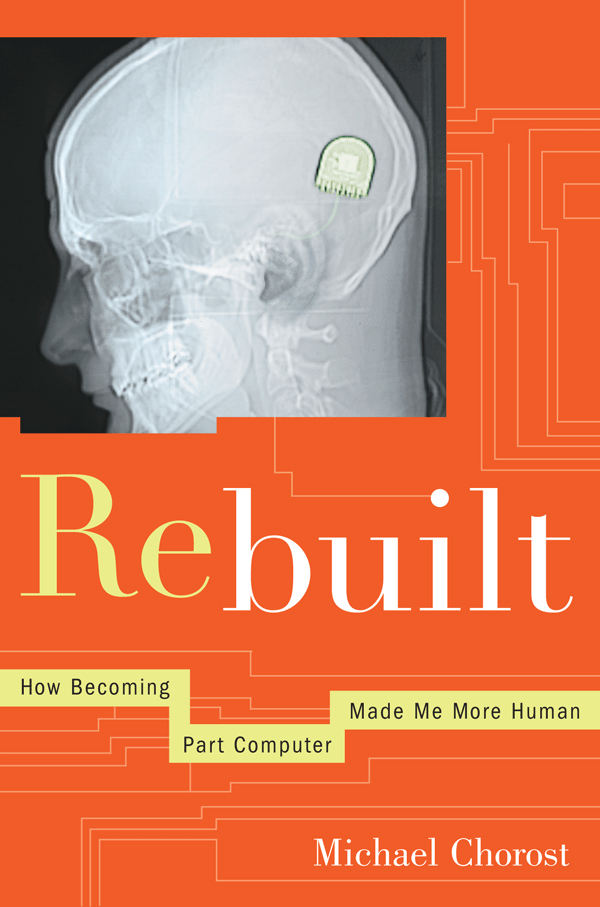
Michael Chorost (pronounced “kor-istˮ) is a book author and public speaker. His first book, Rebuilt: How Becoming Part Computer Made Me More Human, is a memoir of going deaf and getting a cochlear implant. It won the PEN/USA Award for Creative Nonfiction in 2006. His second book, World Wide Mind, is about the science of brainscanning and the prospect of enabling direct communication from one brain to another. He has also written for Wired, the Chronicle for Higher Education, and New Scientist, among others. He lives in Washington, D.C. with his wife and their two cats.
About the Book Project
HOW TO TALK TO ALIENS is about four graduate students who journey to Formicaris, a high-gravity planet, to learn how to negotiate with a rogue ant colony threatening humanity on Earth. They must learn to think and speak like the hives of Formicaris, or suffer extinction.

Praise for Michael's Work
“Funny and thoughtful... Rebuilt may be the first of a new genre: the cyborg memoir.”
—L.A. Times
“Chorost's graceful, poetic turns of phrase and dry, self-deprecating humor take what could have been a dry technological story and breathe life into it.”
—Library Journal on Rebuilt
“Michael Chorost is not only a clear and concise science writer, but also a visionary.”
—The New York Times
“Chorost's greatest achievement is in making his tale not just one about transistors and neuroscience, but about the future of humanity and love.”
—Joel Garreau, Author, Radical Evolution on World Wide Mind
“World Wide Mind is a rare pleasure indeed: a smart book about the future of technology that is really about the complexities of the human heart and the universal yearning to be transformed by connection.”
—Steve Silberman, Contributing editor, Wired
“Chorost has a unique perspective that enables him to foresee how mind technologies will impact everyday issues of existence.”
—Ed Boyden, MIT Media Lab on World Wide Mind
Also by Michael Chorost

Featured Article
In Modified: Living as a Cyborg, ed. Chris Hables Gray, Heidi J. Figureoa-Sarriera, and Steven Mentor. Routledge, 2021, p. 108. I tried–perhaps not very successfully–to connect my experience as a cochlear implant user to my grassroots political work between 2017 and 2020.
Latest Blog Post
I got into science writing in an unusual way. I was trained as an academic, completing my Ph.D. in educational technology in 2000. In 2001 I abruptly lost my hearing and got a cochlear implant. When my audiologist first showed me an implant without its ceramic casing I thought, “Oh my God, it really is…