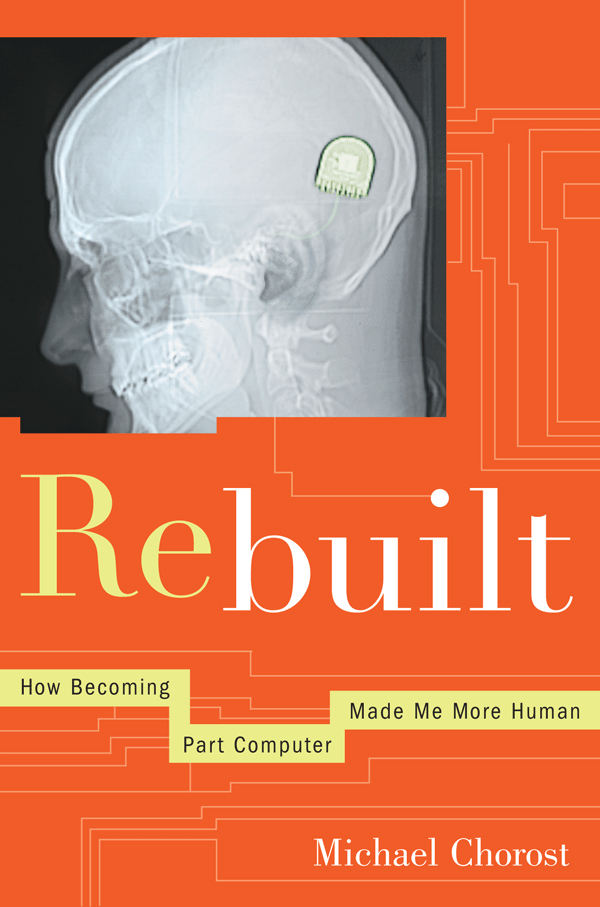
Michael Chorost: Michael Chorost, author of <i>Rebuilt</i>, on cochlear implants
RSS Feed Subscribe to RSS Feed.

My latest Technology Review article, Helping the Deaf Hear Music, came out today. This piece is about a new test, the Clinical Assessment of Music Perception (CAMP), that’s been developed by Jay Rubinstein and his colleagues at the University of Washington and the University of Iowa. It measures how well cochlear implant users hear the basic components of music: pitch, timbre, and melody. As it happens, I was one of the subjects in early trials of CAMP, and I talk about my experience in the piece. The highlight, though, is the extraordinary score posted by John Redden, a deaf musician: 100%. How John did it is still something of a mystery and, I hope, a portent of the future.

And maybe there’s some cosmic rule that when you write, you get written about. In today’s New York Times there’s an article titled Cochlear Implant Supports an Author’s Active Life. No, it’s not about me. It’s about Josh Swiller, author of The Unheard: A Memoir of Deafness and Africa. But Josh was nice enough to mention that he read my book while making the decision to get the implant. Thanks, Josh, and congratulations on the publicity.


Dear readers, I’ve been running silent for a while because I had two deadlines last week, for Technology Review and The Journal of Life Sciences. I was also sick with a cold. But the stories will interest you, and I’ll post links to them when they come out. I’m enjoying life as a two-eared person and will be back to posting after a bit of a rest!


Windows is the operating system of the PC, but Google is quickly becoming the operating system of the world. I’ve found that I can’t write anymore without Google. I probably do five or six searches each hour, looking up various facts.

So I spent a good deal of today sniffing ’round the place. I had lunch with Jenn Shreve, a wonderfully creative writer who’s now working at their Mountain View campus. Eating in Google’s cafeteria is like living in a Star Trek post-cash economy of abundance. You don’t buy anything. You just take whatever you want. After lunch Jenn showed me a stunning display of a rotating earth showing, graphically, how many searches were going on around the globe in real time. It gave the impression of a planet glowing with data — although large parts of Africa and Asia were almost entirely dark. There’s still a long way to go.

Then I went to an open house in their San Francisco office. I went mainly to see Vinton Cerf, who wrote the Internet’s fundamental protocol, TCP/IP. Cerf has a hearing loss, as does his wife, who is a cochlear implant user. He got quite excited when I gave him a copy of my book, because he’d read my Wired article on software for music — which made me turn pink with pleasure. It’s a lot of fun to be recognized.

Cerf gave a marvelous talk on the challenges that face the Internet now, such as the fact that it’s fast running out of IP addresses (its current capacity of 4.3 billion addresses seemed like plenty back in the 1970s, but, well, things have changed since then.) There’s big social challenges too, like ensuring both security and anonymity at the same time, and working through its impact in countries that don’t have the same rules as Americans do about things like freedom of speech. He’s a great speaker: funny, fast, smart, engaging.

Then I went to see a jazz concert at Yoshi’s with a friend, and that’s a whole nother blog entry. But to keep it brief, I made two interesting discoveries. One is that jazz isn’t the right musical form for me right now; it’s so improvisational and sophisticated that for me it’s like a beginning English speaker going to a debate at Oxford. But there were particular passages that I enjoyed, where the instruments were harmonizing closely together in a way that sounded more symphonic than improvisational. And I got the sense - it’s just a sense - that my new right ear was getting the music better than the left. Not that it was hearing more, but that it was enjoying it more. A hemispheric lateralization thing, perhaps.

Well, it’s late; it’s been a long day; tomorrow I give a talk at the Institute for the Future, so I’m going to bed.


February 6, 2008: Various bits of good news

Yesterday was an amazing day because I inked deals for three speaking engagements: one at my alma mater Brown, one at a government policy conference near Yellowstone Park in Montana, and one at the SV Life Sciences CEO Connections Summit in Key Biscayne, Florida. Details on these can be found on the Events page.

Also yesterday, Amazon posted a book I’ve been co-editing, titled “Educating Learning Technology Designers: Guiding and Inspiring Creators of Innovative Educational Tools.” It’ll be published by Routledge this summer.

A few days ago I published Looking into the Brain with Light in Technology Review. This story’s about monitoring oxygen levels in the brain using light. To me this technology seemed almost like magic — a bright laser light illuminates brain tissue through the skull, and ultrasonic waves “tag” a particular location so that its color can be measured by a light detector.

I was told today that in the next few weeks, NPR’s Radiolab show will be airing a show on musical hallucinations in which Oliver Sacks and I are guests. (Back in 2001 I experienced incredibly loud, vivid musical hallucinations during the three months I was totally deaf - the auditory equivalent of phantom limb. They stopped completely when my first implant was activated.)

I was also interviewed by The Economist a few days ago.

My buddy Josh Swiller, author of the remarkable memoir The Unheard: A Story of Deafness and Africa, is giving a talk in the Bay Area next month, March 22nd, at the California A.G. Bell meeting in Milpitas, near San Jose. For details, go to the “Annual Conference” page on their website.

My new right ear’s getting better at understanding speech. I find that when listening to Winnie-the-Pooh tapes I get whole sentences about 30% of the time. Names and numbers are easy; they jump out at me. I’m still not able to get the gist of the story, but the ear is clearly making progress. (My much more experienced left ear understands it easily, of course. It still seems strange — it’s as if half of me knows French fluently while the other half is fumbling around trying to learn it.) I’ll be going to a mapping session on Friday and maybe there I’ll be able to buy some more vowels. (I talked about vowels in my entry Shopping around for vowels.)

So, lots of good news.

I plan to start formally training the ear soon - more on that coming up…


February 5, 2008: A good Two-Eared Party

My Two-Eared Party was this Saturday, and about 25 people came despite it being a cold, rainy night.

My friends held forth on acts of subversion, the thrills & tribulations of L.A. journalism, the mysteries of Nepal, sleeping on the floors of bus stations while traveling through 48 states to document people in the act of reading, the challenges of living with another person, the secrets of localizing sounds from above and below, the secrets of managing faculty careers, gallery openings by gay deaf artists, unexpected bus-stop encounters decades ago, various novels, and five-month-old babies.

It wasn’t particularly ritualistic. (I wrote about the need for ritual in my blog entry, Rituals of Getting a New Body Part.) I realized, as I put another bag of popcorn in the microwave, that it’s hard to create a sense of sacred time & space when you have to watch the wine bottles and make sure the chips haven’t run out. I think it’s going to take a few more centuries to work out how to do such things.

But it was a great party. And boy, having the second ear helped. It’s a great feeling to sit between two people and hear both of them.


I was walking up one of San Francisco’s many hills when I heard the shouting and laughing of children behind me.

Behind me? How did I know that?

Oh, right: I have two ears now.

I stopped and looked around. They sounded loud, and close. But I couldn’t see them.

Where were they?

I slowly pivoted in a circle to see what I heard in every direction. I had done this before with one ear, without success. Months ago, walking down Elizabeth Street , I had heard music on the air – perhaps a band practicing in a garage or backyard. It had sounded live, somehow. I’d stopped and looked around, trying to find it. But I couldn’t. The music was everywhere and nowhere at once. Placeless, undefined, omnipresent.

But now, today, the laughter and shouts sounded different at every point of the compass. I could feel it increasing in one ear at the same time that it diminished in the other ear. And there came a point, in one particular direction, that both ears came into synchrony. My body said: There. It’s there.

There are two different ways the brain uses to locate a sound. One is loudness difference, since one ear is further from the source than the other and “shadowed” by the head. The other is timing difference, since the sound arrives at the ears at different times. Was I hearing loudness difference, timing difference, or both?

An academic question, at the moment. I walked on, and five steps later, as I reached a crest, I saw them. Down the hill, two blocks away, the local schoolyard was full of children.

I was right.

Well, almost right: I’d been about ten degrees off.

I’m still working on balancing my ears. At the same spot on the volume wheel, they hear different loudnesses. So I was probably thrown off by that.

But just a bit. They were there, and I knew it.

(N.B. Check out this just-published study showing that people with one CI do much worse at localization than people with two CIs. Thanks to Ulf Nagel’s blog for pointing me to it.)


January 30, 2008: Earpiphanies

When I woke up on Monday my left ear – the one implanted since 2001 – sounded different. Gritty, hollow. My voice sounded remote and thin. When I moved a soda can on my coffee table, it made a tinny sound.

I pondered that as I brushed my teeth. Sometimes the ear abruptly sounds different, and it either slowly returns to “normal” or I adjust to it. I’ve never figured out why. I’ve learned not to worry about it.

But the timing was odd. I’d heard stories – just rumors, really – that when a person goes bilateral, the original ear gets worse for a while. Why, no one seems to know.

And here I was, four days post, with a left ear that suddenly sounded gritty and hollow.

The ear had taken a beating in the past four days. Every keystroke and every phoneme going into the new right ear had made the left one ring for several seconds afterward. Typing my name, M-I-K-E, sounded like this:

tap-bing tap-bing tap-bing tap-bingggggggg

And the right ear, the new one, was massively overstimulated. Every night when I took off the processors both ears were howling. Roaring sounds, rushing sounds, bits and scraps of music.

Could it be, I wondered, that the left ear was simply tired?

I shouldered my backpack and walked down to my office. Not knowing what my nervous system was up to. My body was changing on me, in obscure ways. My footsteps sounded heavy and dull in the rain.

I work in a converted Victorian flat turned into a minature warren of writers’ offices. It’s always been a hard environment for listening, with high ceilings, narrow hallways, and wooden floors. How would I do today?

Badly, it turned out. I visited Scott James in his office and missed two words in the very first sentence he said to me. Diane Weipert came by and I found myself skidding against her words, unable to find footing in them. When people were hanging out in the kitchen I stayed in my office, bewildered and confused. How could this be happening after my spectacular successes in cafes on Thursday and Saturday?

At the end of the day I stopped by Diane’s office. “Those headphones I loaned you,” I said. “Can I have them back?” They were high-quality headphones I’d gotten some time ago, but they hadn’t done much for me.

At home I looked at my CD player and thought, I might as well plug them in and see what happens.

I put my left processor on Fidelity 120 and turned the right one way up. Gingerly, I put the headphones on. They fit snugly over both processors. The headpieces stuck out: from the back, it probably looked like they were trying to escape.

I got into bed. Elvis hopped up and settled down with his front paws on my left ankle.

I chose a classical CD with Debussy’s Clair de lune – two instruments only, oboe and harp. It was a slow, meandering piece, tones and glissades. I could feel the right ear feeding me the soundstream. I took off the left headpiece to isolate the right: yes, it was working. It didn’t sound as limpid and clear as the left, but it was giving me music, mirroring the left.

Mirroring? Actually, no, I realized. The headphones were shifting the sound intensities back and forth between them, playing off of each other.

Stereo.

And I was caught up in it: following the contours of the piece, its wholeness, its probing of the emotional resonances of sound; a moonlit glade with the stars wheeling overhead.

“It sounds lovely,” I breathed.

Wow.

It held my attention the way a good story does. I listened to it three more times, once with only the right, once only with the left, then once with both again. Disassembling and reassembling the piece.

If it sounded this good to me, what must it sound like to a person with normal ears?

The next piece was Sibelius’s Valse triste, and I heard its ominous undercurrent – the shifty rhythm beating underneath the strings.

I moved on to Mendelssohn’s Wedding March, which I’d heard many times before. Now, though, I realized that listening to it with one ear had been as pointless as walking down the aisle alone.

That’s because music reaches into you and works on your brain. And to do it, it needs to work with all of the brain. Hearing music with only one ear engages only half of the brain. And half is not enough. It just isn’t.

The March is about twos and joys, climaxes and beginnings. I thought of my friend Joe’s wedding to his wife Heather, and of how her beige gown swirled as she danced on the floor, and of the joy they and I felt that day. I welled up a bit, to my surprise. But that’s what music is supposed to do. Hearing it in both ears was like the difference between a live and a dead body: the form was the same, but the experience was oh so different.

And then I ate the rest of the CD. I listened to all of it: Brahms, Vivaldi, Tchaikovsky. Well, actually, I left the 1812 Overture for another day because it was three o’clock in the morning. I took my processors off, stuck the batteries in the charger, and went to sleep.

I learned more about music in one day than I had in the past thirty years.

The next day, I did a lot better in the office. I think it was the echoes that had confused me: I hadn’t heard reverb in both ears in decades.

And I discovered that I was hearing much less of the bing in my left ear. But that’s another story.